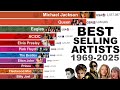
Best-Selling Music Artists (1969–2025) | The Race of Music Legends
Discover the best-selling music artists of all time in this epic animated bar chart race — from The Beatles and Elvis Presley to Michael Jackson, Madonna, Eminem, BTS, and Taylor Swift. Watch how global music sales evolved year by year from 1969 to 2025, revealing who truly dominated the charts through five decades of pop, rock, hip-hop, and streaming revolutions.
This ranking is based on yearly certified global record sales. For recent years, figures also include digital downloads and streaming data reported by major music retailers and platforms. Sources: RIAA, IFPI, and official record label reports.
Best-Selling Music Artists (1969–2025) | The Race of Music Legends is a captivating data-driven video that showcases the evolution of the world’s most successful music artists over more than five decades. From the golden age of vinyl records to the era of digital streaming, this video visualizes how legendary performers rose, competed, and dominated global music sales from 1969 to 2025.
The video presents a dynamic bar chart race that highlights cumulative record sales, allowing viewers to clearly see shifts in popularity, cultural impact, and commercial success over time. Iconic artists such as The Beatles, Elvis Presley, Michael Jackson, Madonna, Queen, Eminem, and modern superstars appear as they battle for the top positions, reflecting changing music trends and audience preferences across generations.
This timeline not only celebrates individual achievements but also tells the broader story of the music industry’s transformation — from physical album sales and cassette tapes to CDs, downloads, and streaming platforms. Each year marks a new chapter in music history, revealing how innovation, global reach, and fan loyalty shape long-term success.
Perfect for music lovers, pop culture enthusiasts, and data visualization fans, this video combines nostalgia with insightful analytics. It serves as both an educational resource and an entertaining journey through the careers of the greatest music legends of all time.
If you enjoy music history, best-selling artists rankings, chart races, and industry trends, this video offers a unique perspective on who truly ruled the music world from 1969 to 2025 — and why their legacy still matters today.
2025
This chart offers a fascinating snapshot of the best-selling music artists from 1969 to 2025, highlighting how pop dominance has evolved over generations. As of March 2025, Taylor Swift sits firmly at the top, reinforcing her status as a once-in-a-generation superstar.
She’s not only dominating sales, but also holds records for album re-recordings (Taylor’s Version) outperforming original releases—something almost unheard of in music history.
Close behind, The Weeknd and Bruno Mars showcase how global appeal and streaming-era longevity can rival traditional pop stardom.
The Weeknd is one of the most-streamed artists of all time, despite rarely doing traditional promo interviews. Justin Bieber and Ed Sheeran represent the early 2010s digital explosion, when YouTube and streaming reshaped how artists broke through.
It’s also interesting to see genre diversity: Zach Bryan brings country into the mainstream conversation, while Billie Eilish proves minimalism can be massively successful.
Meanwhile, legacy bands like Coldplay remind us that consistency over decades still pays off. Overall, the chart captures not just sales, but cultural impact across eras.
Fun Facts & Trivia
Taylor Swift is the only artist in the chart who boosted sales by re-recording old albums—Taylor’s Version releases counted as new commercial peaks.
The Weeknd holds the record for most monthly listeners on Spotify history, proving that streaming power now rivals physical sales.
Bruno Mars has one of the highest sales-per-album ratios ever, meaning fewer releases but massive impact each time.
Justin Bieber was the first artist discovered on YouTube to reach global best-selling status.
Ed Sheeran’s Divide tour remains the highest-grossing tour of all time, despite his minimalist “guy-with-a-guitar” image.
Zach Bryan is a rare case of a country artist achieving mainstream dominance without traditional radio-heavy promotion.
Billie Eilish became the youngest artist to sweep all four major Grammy categories in one night.
Coldplay are the only band on the list with consistent top-tier sales across three different decades.
Ariana Grande achieved multiple #1 debuts in the same year—something only a handful of artists have ever done.
The chart shows how streaming-era artists now catch up faster to legends than ever before.
1976
This chart captures a golden moment in music history, spotlighting the best-selling artists up to December 1976, an era dominated by bands and timeless songwriting. Sitting at the top, Eagles embody the sound of the American Dream, blending rock, country, and folk into massive commercial success. Fun fact: Their Greatest Hits (1971–1975) is one of the best-selling albums of all time, even decades later.
Just behind them, Elvis Presley represents the bridge between early rock ’n’ roll and mainstream pop culture, while Elton John and Billy Joel prove the power of singer-songwriters in the vinyl era. Trivia: Elton John once released two No.1 albums in the same year—an almost unthinkable feat at the time.
British bands dominate the list, with The Beatles, Queen, Led Zeppelin, and Pink Floyd shaping rock’s artistic and experimental boundaries. Notably, ABBA stands out as a global pop phenomenon from Sweden, proving English-language pop wasn’t limited to the US or UK. Overall, the chart reflects an era where albums—not singles—defined legacy and cultural impact.
Fun Facts & Trivia
Eagles hold one of the best-selling albums of all time in the U.S. with Their Greatest Hits (1971–1975), rivaling even Thriller decades later.
Elvis Presley was past his commercial peak by 1976, yet still ranked among the top sellers—proof of unmatched cultural legacy.
The Beatles had already broken up six years earlier, but continued outselling many active artists.
Queen had just released Bohemian Rhapsody, a song initially considered “too long” for radio, before becoming one of the most iconic tracks ever.
Led Zeppelin famously avoided releasing singles, relying almost entirely on album sales—rare even for the 1970s.
Pink Floyd were riding the momentum of The Dark Side of the Moon, which stayed on the charts for over 14 consecutive years.
ABBA are the only non-UK/US act on the list, marking one of the first truly global pop breakthroughs.
Billy Joel and Neil Diamond highlight the era when singer-songwriters dominated both charts and radio.
The chart reflects a time when albums—not singles—defined success, long before streaming reshaped the industry.
Similar Posts
Source: GlobalStats